The Salami Strategy
The Trump administration's transfer of national forest management to the states is hiding in plain sight—a coordinated strategy visible only if you're tracking all of it at once.

When you turn fifty, it can be a little humiliating to realize how little you’ve retained from your college years. It can also be hilarious to catalog the random facts and learnings that actually did stick. For me, one of those is a term of art I learned about in a public policy seminar my junior year: salami tactics.
The Hungarian phrase szalámitaktika was coined by Mátyás Rákosi (that part I had to look up!), the communist leader who slowly consolidated one-party control of postwar Budapest. He was describing his strategy of cutting the opposition into slices thin enough that no individual cut provoked the resistance a frontal assault might have. The concept lives on today because the underlying logic applies whenever a large transformation needs to be achieved through smaller moves that won’t trigger the alarm of the opposition.
I was reminded of the term recently while watching what the Trump administration is doing on our national forests. Their decision-by-decision dismantling of federal forest stewardship is a perfect encapsulation of salami tactics. The moves are all real and public: a March 2025 executive order declaring domestic timber production a national security priority; a secretarial “emergency” declaration to bypass environmental review on more than half of Forest Service land; the elimination of nearly 6,000 Forest Service positions; a proposed budget cutting billions from agency funding; the March 2026 reorganization relocating Forest Service headquarters to Salt Lake City and dissolving its nine regional offices into 15 state directors.
These events have all been out in the open, but none of them individually have triggered a unified pushback—at least not on order of what we saw in response last summer to Utah Senator Mike Lee’s proposal to sell off millions of acres of public lands.

Another series of slices have gotten even less attention recently: the federal-state shared “national forest stewardship agreements” being dribbled out one by one with Montana, Idaho, Wyoming, Utah, and, as of last week, South Dakota. No single agreement on that list is the story, and indeed, individually, they each got some local attention. The collective meaning of those agreements, however, is a national story we should all be paying attention to. In short, state governments are suddenly being embedded into federal forest decision-making.
What the list describes is the slow transfer of stewardship of millions of acres of publicly owned forests away from a federal agency with a national mandate and toward state capitals where the timber industry, ranching interests, and extractive economy hold substantially more political sway. The national forests will look the same for a while, but the authority over them—who decides what gets cut, what gets protected, and in whose interest—is already becoming something else. And I don’t think it’s being paranoid to imagine that transformation is designed to be obvious only in the rearview mirror.
The arguments for these state agreements sound reasonable on the surface:
States know their own forests best!
Local managers make better decisions than distant bureaucrats!
The federal government is too darned slow and too burdened by antiquated processes!
There is a kernel of truth in each of those claims. But those are already failed arguments when tested against history.
National forests were placed under federal stewardship specifically because state-level management, in the late 19th and early 20th centuries, had proven incapable of resisting the pressure to liquidate them. Gifford Pinchot built the Forest Service’s mandate on the explicit recognition that states—particularly in the West, where extraction industries dominated political economies—could not be trusted to manage lands held in common for the whole nation. It was an acknowledgment of a basic political reality: the interests that hold the most sway on resource decisions at the state level are not the interests of the 330 million Americans who own those forests in common. It’s the industries that operate within state borders. (Let me pause here to explicitly state that I definitely don’t remember any of this from college. I only know that backstory because last summer I read the single best history of America’s public lands, John Leshy’s Our Common Ground.)
The Sagebrush Rebellion of the 1970s and early 1980s tested this idea. Western ranchers, miners, and developers, feeling that federal regulations impeded economic development, mounted a sustained movement to transfer federal lands to state control, backed by Ronald Reagan and his Interior Secretary, James Watt. (Book recommendation #2: Jonathan Thompson’s Sagebrush Empire.)
That movement ultimately failed because the underlying case collapsed under scrutiny. Even ranchers sympathetic to the rebellion’s goals found that state land management typically came with grazing fees 50 percent or more above federal rates, making state control economically unattractive. More important for today’s debates is that any state action to wrest control of public lands from Congress faced longstanding precedent with no realistic legal path to reversal. The Rebellion tried a frontal assault, but what the movement really required was salami tactics.
This is what the current administration has grasped. They don’t need to transfer title to transfer control. The recent state-level stewardship agreements leave federal ownership legally intact while shifting some decision-making authority. Instead of selling off these lands, the administration is diluting its administrative role, agreement by agreement—and, to date, below the threshold of organized resistance.
Along with employing classic szalámitaktika, they’ve stumbled upon an ingenious rhetorical cover. The state agreements are nearly always framed as wildfire risk reduction—faster decisions, more active management, less federal red tape. But the agency being restructured to fight fires faster is simultaneously losing the scientists, ecologists, and planning staff whose work determines whether interventions actually reduce fire risk or simply prioritize board-feet over forest resilience and call it “prevention.” Commercial logging, the primary beneficiary of these agreements, can actually increase fire risk by removing the large trees most resistant to fire and leaving behind the slash and understory growth most likely to burn. (The emergency declaration that bypassed NEPA review and the proposal to rescind the Roadless Rule were also justified on wildfire-risk grounds.)
And it‘s the human capacity that make federal stewardship possible—and why these seemingly logical cooperative agreements will be so difficult to reverse. A future administration can cancel all of them, but good luck reassembling a generation of ecologists, hydrologists, and fire managers who left the agency, dispersed into other careers, and took decades of place-specific knowledge with them.
Neither can a future administration assume the problem will hold until they arrive. The reorganization is being implemented on a timeline designed to be largely complete before the next election, and the workforce losses are happening now. The administration is making a bet that all these changes can be locked in before they become legible as a unified strategy to a public and a press corps trained to cover events rather than patterns.
In fact, we’re watching that exact dynamic as I write this. In the past 24 hours, Senator Mike Lee’s amendment to nullify the Roadless Rule generated more than a dozen stories in national outlets. The five state stewardship agreements signed over the past year—which are already in effect and now cover nearly a million acres in Montana alone—have generated almost none. Lee’s decision to add an amendment to the Wildfire Prevention Act to rescind the Roadless Rule was certainly brazen, but it is also very unlikely to get the required 60 votes in the Senate to pass. Meanwhile, the individual forest stewardship agreements fly under the radar nationally. So do reorganization charts, or budget lines eliminating state forestry grants, or the closure of a research office. Each slice is simply too thin to cut through the noise.
Activating the Public Lands Press Corps
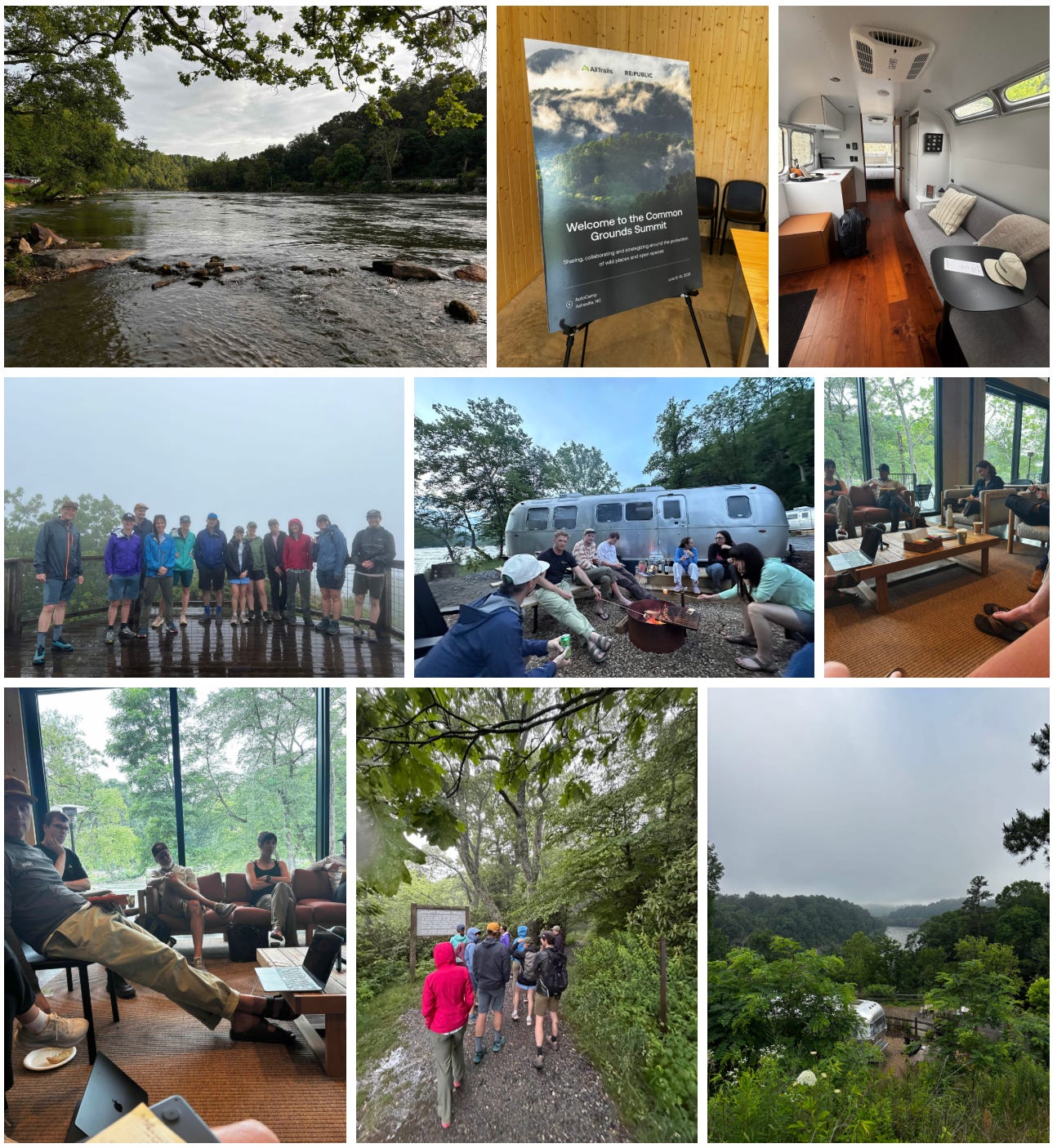
Earlier this week, RE:PUBLIC co-hosted the inaugural Common Grounds Summit with AllTrails in Asheville, North Carolina—two days of conversation, collaboration, Airstream living (thanks to our hosts, AutoCamp), and one very wet hike up Mount Pisgah with a dozen of the most important voices covering America’s public lands.
The gathering brought together journalists and thinkers from across the public lands media and communications ecosystem: Pitt Grewe, head of social and environmental impact at AllTrails, and his colleagues Sarah Owen and Lyle Jarvis; Meg Carney, founder of the Outdoor Minimalist; Chris D’Angelo, co-founder of Public Domain; Joe O’Connor, managing editor of Mountain Journal; Dillon Osleger, an independent writer, RE:PUBLIC contributor, and author of Trail Work; Lauren Bogard, Deputy Director at Center for Western Priorities; Christine Peterson, an independent journalist for High Country News and Outdoor Life; Graham Averill, national parks correspondent for Outside; and RE:PUBLIC’s editorial director Elizabeth Hightower Allen.
Public lands journalism is a lonely and (lately) exhausting beat. The reporters who cover it are often dispersed across small outlets and Substacks, working independently on stories that rarely get the attention they deserve. The Common Grounds Summit was designed to change that—to create camaraderie, a support system, cross-pollination, and collective momentum.
What emerged over two days of meetings beside the French Broad River was exactly that. Story ideas were surfaced that have gone uncovered or undercovered by the mainstream press. Connections were made between organizations who can amplify one another’s work. And AllTrails shared updates on its robust Public Lands Program, which includes compelling user data and trends that can sharpen the angles and inform the reporting all of us pursue.
The timing of this meeting felt significant. The day before we convened, former 60 Minutes correspondent Scott Pelley gave a widely-shared interview about the recent unraveling of one of America’s great journalistic institutions. And on Monday, the day we met up, Politico announced it was folding E&E News, one of the most reliable sources of environmental coverage in Washington, D.C. It was a reminder (as if we needed one) of how tenuous the ground is beneath independent journalism right now—and how critical it is that outlets covering the public interest find ways to sustain and strengthen their work.
RE:PUBLIC exists precisely for this moment. We left Asheville energized by the caliber of the journalists joining us in the room, the story ideas generated, and the potential for this to become an expanded annual gathering with more stakeholders involved. We’re grateful to AllTrails for bringing this group together and for their ongoing investment in public lands storytelling.
This is what capacity building looks like—small steps that can grow into a larger movement. We hope you’ll be part of what comes next.
ICYMI: The Senator and the Broken Wing
Our latest co-published investigation, in partnership with ProPublica, explores a Montana senator’s ties to a private wildfire-fighting business. Before he was elected to the U.S. Senate in 2024, Republican Tim Sheehy ran an aerial firefighting company called Bridger Aerospace, which sends scoopers—aircraft that drop water from lakes and oceans onto wildfires—to combat blazes around the West. And a little over a year ago, a plan leaked from Sheehy’s office to expand the use of private planes to fight wildfires while eliminating the U.S. Forest Service’s rigorous checks for those aircrafts.
It’s a stunning report backed by documents obtained through the Freedom of Information Act. Streep’s story took months to report, and it’s the kind of dogged, accountability journalism that wouldn’t exist without the generous support of readers. If you enjoyed his story and the other important work RE:PUBLIC has been publishing recently—and you haven’t yet donated to help fund our newsroom—we hope you’ll do so today.
The Good, the Bad, and the Ugly
Every Friday, our team shares critical stories about public lands from around the internet. This list could be exhaustive and exhausting, but our intent is to inform, not overwhelm. Instead, we choose three to five important stories you should be aware of—including at least one piece of good news.
The Good: Congress Is Moving to Extend the Legacy Restoration Fund (Outdoor Alliance): “For the past five years, the Legacy Restoration Fund (LRF) has helped address one of the biggest challenges facing America’s public lands: a growing backlog of maintenance projects on parks and other public lands that Americans depend on for outdoor recreation experiences.
Created through the bipartisan Great American Outdoors Act in 2020, the LRF has funded deferred maintenance—critical improvements to trails, campgrounds, bridges, roads, trailheads, visitor facilities, and other infrastructure that agencies are not able to address through regular funding sources. These investments help keep public lands safe, accessible, and enjoyable for the millions of people who visit them every year.”
The Bad: Senate Republicans Advance Bill That Nullifies the Overwhelmingly Popular Roadless Rule (Our Public Lands & Waters): “Last June, almost a year ago, Secretary of Agriculture Brooke Rollins formally announced that her agency would roll back the Roadless Rule, a process that still hasn’t fully played out and hasn’t involved feedback from the American public yet. An environmental impact statement is expected any week now, at the latest by the end of this summer. Rollins called the rule ‘overly restrictive’ and ‘absurd obstacles to common sense management of our natural resources.’ In Congress, too, Republicans have been hard at work trying to repeal this conservation rule that’s supported by the overwhelming majority of Americans.”
The Ugly: 2027 May Be a Disaster for Public Lands if This Funding Bill Passes (Gear Junkie): “By October each year, the government has to pass its budget for the next fiscal year. While that deadline is still a few months away, the House is beginning to work on budget bills, meaning the public is getting its first glimpse at what may happen to public lands. A recently introduced appropriations act would affect several agencies, endangered species, hunting and fishing, and national parks.”
“Environmental and conservation groups were quick to criticize the bill. The Center for Biological Diversity called it a ‘disgrace.’ ‘This morally bankrupt bill will only lead to dirtier air, more toxic water, and countless species shoved over the extinction cliff. Future generations will pay the price for this staggering level of political irresponsibility,’ Stephanie Kurose, deputy director of government affairs, said in a press release.”