The Colorado River Math Problem
With federal guidelines expiring and reservoirs near record lows, a veteran attorney explains how seven states might—or might not—divide what's left.

Ever since we launched RE:PUBLIC, we’ve been following the slow-motion car crash playing out on the Colorado River—surfacing in the headlines for a week and then receding, in fits and starts. A bad snowpack number here, a tense round of negotiations there, a federal deadline inching closer. Lately those fragments have started to add up, and the wreck is no longer slow or distant. Things are coming to a head, so we decided it was time to slow down, understand it properly, and talk to an expert to provide readers the context to make sense of what’s coming next.
First, the basic background: Across seven states, 40 million people depend on the Colorado River as an integral source of water. After a dry winter and low snow-pack levels across the region, reliance on the river has only intensified.
The 1922 Colorado River Compact is the foundational framework for sharing the river’s water, dividing resources between the Upper Basin (Colorado, New Mexico, Utah, and Wyoming) and the Lower Basin (Arizona, California, and Nevada). The century-old compact can’t keep pace with today’s drastic shifts in temperature and precipitation, and given that the Bureau of Reclamation’s operational guidelines for using the river will expire at the end of this year, the question of the river’s future has reached a contentious boiling point. With uncertainty looming for both the Upper and Lower Basins, the possibility of states suing one another has become increasingly likely. How will the fate of the Colorado River be decided among seven water-insecure states?
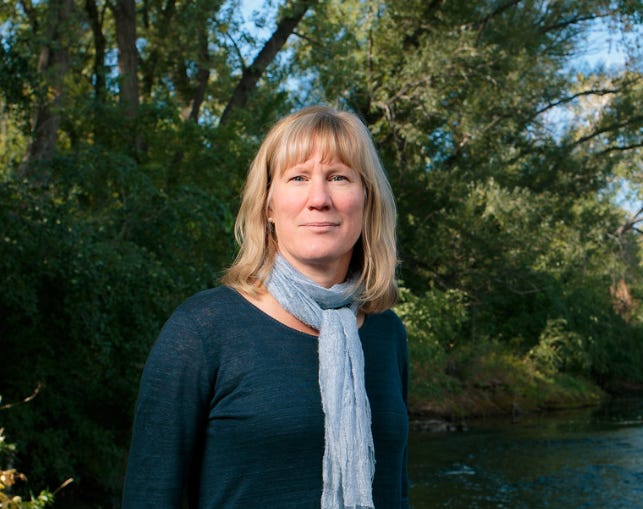
Taylor Hawes, Special Policy Advisor for the Nature Conservancy’s Colorado River Program, has been steeped in the river’s issues for thirty years. A water lawyer by training, Hawes started work in the headwaters of the Colorado River before moving on to serve as an attorney at the Colorado River District. From there, she helped start the Colorado River Program at the Nature Conservancy and served as the program’s director for 18 years. From the midst of negotiations over a new allocation system for the river, Hawes spoke with RE:PUBLIC to help pull back the curtain on this issue. —Campbell Leonard
RE:PUBLIC: How would you describe this particular moment with the Colorado River?
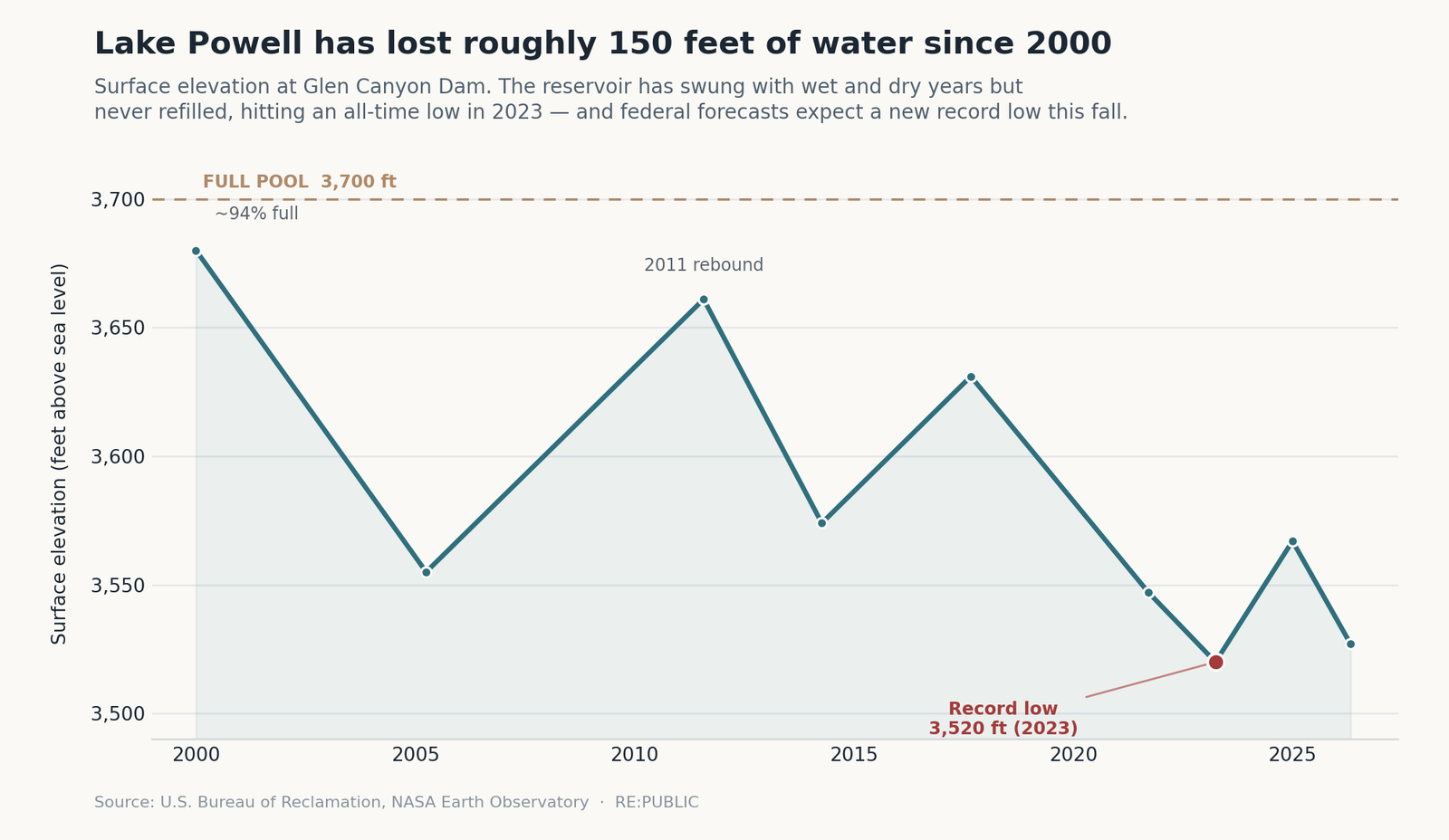
Taylor Hawes: To boil it down, there are really three elements at play: One is that we’re using more water than the river provides. That’s why you’re seeing Lake Powell and Lake Mead drop year in and year out. We’re bumping along the bottom because we are overusing what the river’s providing.
The second piece, which is very related, is that we are the poster child for climate change-driven drought. Climate change is water change, so you’re going to see more extreme weather events, like droughts or floods. We have seen a reduction in flows in the Colorado River basin of about 20 percent since the year 2000. It’s not rebounding. For every increased degree Fahrenheit in temperature, we see a corresponding reduction in flows of about 3 to 5 percent. The climate change piece is playing out in our lifetime.
And the third element?
The third piece of the problem is that we have 20th-century governance and promises for a 21st-century challenge. The Colorado River Compact at the time it was written was a really important document. It promoted peace on the river by allocating it in a way that felt fair. The intentions were good, but it created a sense of entitlement, a promise that every state is supposed to get a certain amount of water. And yet, because of the first two factors I mentioned, especially the climate change–driven drought piece, the water isn’t there. This is what we call the math problem: it describes what was allocated, with the Upper Basin and Lower Basin receiving 7.5 million acre feet plus an extra million acre feet to Arizona from their tributaries, and 1.5 million acre feet for Mexico. If you add all that up, it’s 17.5 million acre feet. However, the river in the last 20 years has been averaging less than 12.5 million acre feet. People were promised something that is no longer there, and yet no state wants to give up that promise.
CL: Do you anticipate that the federal government will have to step in and solve this conflict?
TH: They will solve a piece of it. They will put out a proposed operating plan in the form of a preferred alternative in the final environmental impact statement (EIS) in the next month, by the end of July. But it’s not going to be a consensus. Scott Cameron, the acting Bureau of Reclamation Commissioner, said at a conference a couple of weeks ago, “Pretty much nobody likes it [the EIS]. Which means, maybe we did something right.” It’s likely going to be a ten-year framework with renegotiations every two years to create short-term operating plans, which in water time is terrible. My sense is that the federal government is hopeful that, by requiring new plans every two years, the states will come back to the table and finally get to a longer-term compromise.
CL: What do you imagine these legal battles among the states might look like?
TH: There are a lot of tripwires that could send us to court. The first is NEPA, the federal environmental impact statement process. There could easily be litigation over that with one of the states, a tribe, or an environmental group. The tribes could argue that the federal government is not honoring its agreement as a trustee for tribes, because maybe it is favoring Lower Basin tribes over Upper Basin tribes.
The litigation for that wouldn’t start until the record of decision is issued, most likely in August. Then the new rules will be implemented on October 1. Nobody can sue until the record of decision is issued, when parties can claim that they were injured.
The bigger, more worrisome course of litigation is over the compact itself. The Upper Basin states will likely argue, ’The Lower Basin has been overusing, and that’s why there’s no surplus. They’ve used more than their allocation, they’ve used all the surplus, and they have drained the reserviors. We shouldn’t be penalized for that.′
Arizona has been threatening litigation openly, and once a state sues over the compact, you head directly to the Supreme Court. Then you’re in court for, best-case scenario ten years, in a more likely case, twenty.
I think in our case, it could be the most complicated interstate compact litigation the Supreme Court’s ever seen. There are seven states, with really different interpretations of the law. Most litigation does not turn out the way any of the states believe it should. I think if Arizona sues the Upper Basin states over the compact, I would say all states are in at that point–California and Nevada will pile on because they can’t afford not to be in the case. And then there’s the question of how the Tribes fit into all this. There are 30 tribes in the Basin, 22 of which have treaty water rights. If you were to add up all those rights, and they were actually using what they were promised, it’s about 25 percent of the average annual water supply based on recent years. That, of course, sets up a bit of a zero sum game, because if the tribes get their share, that means that some other water users may not get the water that they’ve been using for decades.
CL: What do you think this process means for the future of water rights? Especially as we head into more situations like this one?
TH: Back in 2002, I was working for a coalition of counties up in the Upper Colorado River Basin in Colorado. 2002 was our worst year on record. Prior to that, we might see four or five water bills in the state legislature each year. In 2003, after the drought, we had more than sixty water bills. That’s a lot. The good news about prior appropriation doctrine and related water law is that they can be changed. It’s a statute, so the legislature can change it. So I think you’ll see, as it gets hotter and drier, there will be laws passed and statutes amended throughout the Basin and throughout the West to try to help us all adapt.
The compact, I think, is a very interesting question. One possible outcome is that the Supreme Court throws out the compact or alters it dramatically, because the facts have so materially changed since 1922 that the agreement can no longer be honored. The water just isn’t there.
CL: That would be if someone sues and it goes to the Supreme Court?
TH: Yeah, if it goes to the Supreme Court, which I think is pretty likely. I think all the states will be disappointed with whatever the Supreme Court rules, but there will be more clarity one way or the other from what we have now. Climate change has changed everything we thought we knew about this river, and the Court will probably direct the states to go back to the negotiating table to answer the same question before the states now: How will you share this river as it shrinks?
Grand Staircase Survived Congress. Now the Fight Moves to the Courts.
Last week we wrote about the failed attempt to use the Congressional Review Act to scrap the management plan for Grand Staircase-Escalante. That effort stalled, but if you’ve followed this monument for any length of time, you know the pattern: there’s always a new threat, and always a new front. This week one opened in federal appeals court.
On Tuesday, the 10th Circuit revived Utah’s lawsuit against Grand Staircase and Bears Ears National Monuments. This is the case we went deep on earlier this year, when reporter Alex Heard examined the legal vulnerabilities of the Antiquities Act. Back in 2023, a federal district judge had thrown the lawsuit out, ruling that a president’s decision to draw monument boundaries under the Antiquities Act simply wasn’t something a court could second-guess. Sovereign immunity, the judge said, put the question off-limits. The appeals court disagreed. In a 2-1 decision issued on Tuesday, it held that courts can review these designations, and sent the case back down for a fresh look under what it called the correct standard.
If you read our earlier piece, this is roughly the path one of our sources gamed out months ago: reverse the dismissal, return it to Salt Lake City, and let the real arguments finally get litigated. Those arguments were never actually heard the first time around because the district court dismissed the case before oral argument, so the central disputes are still open.
Those disputes are substantial. Utah’s core claim leans on the Act’s instruction that monuments be “confined to the smallest area compatible” with protecting the objects inside them. The state argues that millions of acres can’t possibly qualify as “smallest,” and it has borrowed its framing directly from Chief Justice John Roberts, who in 2021 openly questioned whether thousands of square miles could really be called an “antiquity.” That statement was widely read as an invitation to challenge the Antiquity Act, and Utah is one of the parties trying to take him up on it.
Here’s what this week’s ruling does and doesn’t mean. It does not declare these monuments illegal. Grand Staircase and Bears Ears remain fully intact and protected while the case proceeds. What it does is reopen the question Utah has wanted to litigate for years: whether a president’s power to protect public land has a hard, court-enforceable limit, or whether that judgment belongs to the executive alone.
What’s worth watching now is the cascade. The case heads back to district court for the review it never got. A separate tribal lawsuit in Washington, challenging whether a president can shrink monuments at all, had been frozen pending this exact decision, and could now start moving. And looming over all of it is the possibility we flagged in our earlier reporting: that one of these Antiquities Act cases eventually reaches a Supreme Court that has signaled it’s curious to hear it.
On Grand Staircase, this is the continuation of a fight, not the end of one. It’s been that way for thirty years—and we’ll keep tracking where it goes. —Christopher Keyes
The Good, the Bad, and the Ugly
Every Friday, our team shares critical stories about public lands from around the internet. This list could be exhaustive and exhausting, but our intent is to inform, not overwhelm. Instead, we choose three to five important stories you should be aware of—including at least one piece of good news.
The Good: Kilian Jornet’s Next Big Challenge: Getting Americans to Care About Protecting Public Lands (Outside Online). “Catalan ultrarunner Kilian Jornet was jogging up the slopes of 14,021-foot Wilson Peak in Colorado’s San Juan Range this past September when he saw an abandoned mining cart sitting against the rocks. Jornet, who was ascending all of the peaks above 14,000 feet in the contiguous United States for a project called States of Elevation, was startled at the discovery.
‘It’s abandoned, it’s not active anymore, but still it’s very shocking,’ Jornet, 38, told Outside. ‘It makes you reflect on all the extraction that has been there.’ Jornet took a personal lesson from the ore cart: when industrialization comes to the wild backcountry, the impact will last for decades or centuries. This year, Jornet is dedicating his ultramarathon racing to a campaign born of this realization. He is promoting the protection of U.S. public lands through branding, online messaging, and interviews.”
The Bad: The Cop-ification of National Park Service Rangers (SFGATE). “National Park Service ranger uniforms are iconic: green pants, gray shirts and a broad-brimmed, flat hat. In the coming months, though, visitors who look closely at the uniforms of law enforcement rangers will notice some small but significant changes the Trump administration hopes will underscore the policing element of the job. Those changes include a switch to external ballistic vest carriers that say “police federal officer” and the introduction of rank insignia, symbolic sleeve patches like stripes or stars that denote a hierarchical ranking as seen in the military. In addition, vehicles that law enforcement rangers drive will soon say “police” on the side.”
The Ugly: Trump administration reopens the door for cyanide bomb use on public lands in Utah, across nation (St George News). “The Trump administration has opened the door for the Bureau of Land Management to reintroduce the use of previously banned M-44 cyanide bombs on BLM public lands across the United States, including in Utah. The M-44 cyanide bombs, which are buried like landmines in the ground and spring-loaded with deadly gas, attract animals with a meat-like scent and release the poison when the animal — or person — tugs on the bait. The bombs are placed by Wildlife Services, a division of the U.S. Department of Agriculture, and paid for by taxpayers; $130,793,645 went to Wildlife Services in 2024, according to Department of Agriculture data.”